
The porcelain mosaic to decorate patterns on the wall partition in the palace of worshipping Tuy Ly Vuong
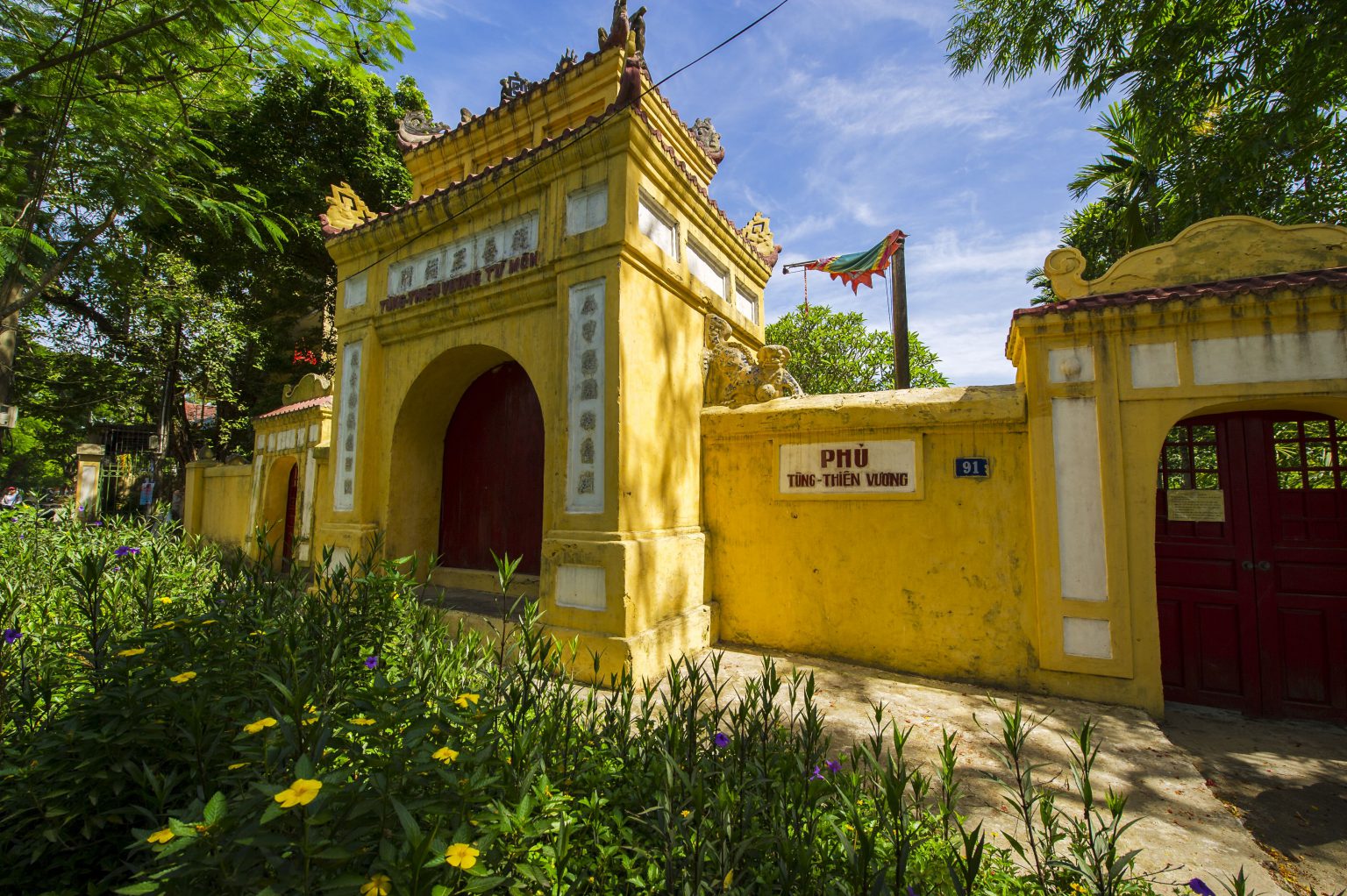
Phu De was the place of residence for the princes and princesses. Once these people passed away, the palaces became the place of worshipping. Each of the Phu De has its own name, depending on the title of the owner. For the princes, the palaces were named after the districts where they were bestowed by the king, such as: Tung Thien Vuong Phu, Tuy Ly Vuong Phu, Gia Hung Vuong Phu, etc. As for the princesses, their places of residence were often named by the title that the king gave them, such as: An Thuong princess De, Ngoc Lam princess De, Ngoc Son princess De... However, people were used to calling the palaces with the intimate name of the palaces for the kings/ queens.

A corner in the palace worshipping Tuy Ly Vuong
In its heyday, there were more than a hundred of Phu De, but there are now only 50 of them remaining and preserving the tradition architecture and style, these are mainly located in areas like Vy Da, Gia Hoi, Kim Long, Phu Cam, Thuy Bieu…Because of the noble title of the princes and princesses, the palaces have the characteristics of large gates, high walls, and beautiful Ruong houses. However, nobody knows clearly how life actually was behind that. Phu De was a place of connection, spreading the royal lifestyle and culture to the folk, thereby contributing to the formation of Hue people’s personality, which is mixed with the elegant and noble characteristics of the Sacred Land. These were also a gathering place for contemporary Hue artists and writers, a meeting place for people coming to read and recite poetry.

A view of Kien Thai Vuong's worshipping palace
The palaces show the intentional combination of architecture and landscape following the principle of "feng shui". It can be said that the architecture of Phu De is like a miniature Hue Citadel, with the wall partition representing Ngu Mountain, the shallow tank representing the Perfume River; the rockery, caves, waterfalls, ornamental plants, and flowers bear unique artistic and cultural values.
The palaces were built with the talent and efforts of royal artisans, using rare local materials. These are architectural works of art that have been refined and perfected over generations. The layout of the palaces was always designed symmetrically, creating a harmonious, delicate and poetic beauty which can still be admired today and reflects the artisanship of the ancients Phu De still keeps much of its original design. The entrance to Phu De follows a winding road between two rows of acalypha siamensis oliv and two rows of royal palm; then comes the wall partition that is big enough to shield the house from all external disasters, but not too high to cover the view of the owners when they want to enjoy the herbs in the garden. Between the wall partition and the house is a shallow tank planted with water lilies and rockeries.

The main architecture is a three compartments and two-lean-to’s Ruong house, with a tiled roof. The truss system is carved with sophisticated patterns. The worship room is the main compartment in the middle, the place to receive guests is mainly the front area of this main compartment or the one to the east. The compartment to the west is the residence of the owners. The horizontal lacquered board (engraved with Chinese characters) and gilded Chinese poems are hung in the middle of the main compartment; on the pillars, there are couplets whose content praises the natural beauty, filial piety and family tradition....
Besides, the early 20th century witnessed the appearance of French architectural style palaces, marking the cultural exchange between the East and the West. Examples of these palaces are Tuyen Hoa Vuong Phu, Tan Phong princess De Trach. Decorative patterns in Phu De which are diverse in style and rich in themes, which is shown in materials such as wood carvings, mortar masonry, porcelain mosaics.... The decorative art values of the palaces played a significant part in the decorative arts of the Nguyen dynasty in particular, and in the source of traditional national art in general.
The diverse green plants in the gardens of Phu De show the rich spiritual life of the owners. When entering a garden, people often feel the coziness and closeness. In combination with the architecture, the gardens help conceal the limited features of the building, creating harmony with the natural landscape. The characteristic of Phu De gardens is the estimated diversity of the plant systems suitable to the climatic conditions of Hue. It is a place of linking nature to people, also a place to remind us about the past.
The cultural space of Phu De preserves the tangible and intangible cultural values of the ancient royal family. Over the years, time has not faded yet the delicate beauty of art, which helps form the typical architectural and cultural beauty of each palace. Phu De is considered a cultural heritage - the living history, and has really become a unique cultural and artistic feature in the current Hue urban architecture heritage foundation. There are many interesting and mysterious stories behind the gates of the palaces that visitors from all over the world, when visiting the ancient capital of Hue, cannot help but be fascinated and long to discover.
Tran Van Dung - Le Huy Hoang Hai


 Tin liên quan


)