Four days after my arrival in Hue, General Prudhomme's entourage brought us the permit when we were hoping to visit the forbidden palace.
The next morning, followed by a gossoon who carries my camera, I crossed the river and entered the Citadel in search of Priest Hoang, the Emperor's finest interpreter, who would facilitate my access to the forbidden palace.
[...]
After passing the gate of Ngo Mon (the meridian gate), we crossed a brick bridge over a half-dried moat, and we set foot on a large courtyard in front of the first palace.
From the ends of the bridge to the palace, stand two porticoes, each is supported by four bronze columns, cast in one piece and decorated with embossed dragon motifs wrapping from the foot to the tops.
Crossbeams are decorated with porcelain plaques of different colors, depicting flowers and various attributes in relief. All these motifs are of remarkable execution.
The large courtyard is flanked by two gilded tigers, resting on a masonry pedestal, sheltered by a small domed roof supported by four columns. It is surmounted by a second smaller one leading to the throne room (Thai Hoa Palace – note by translator).
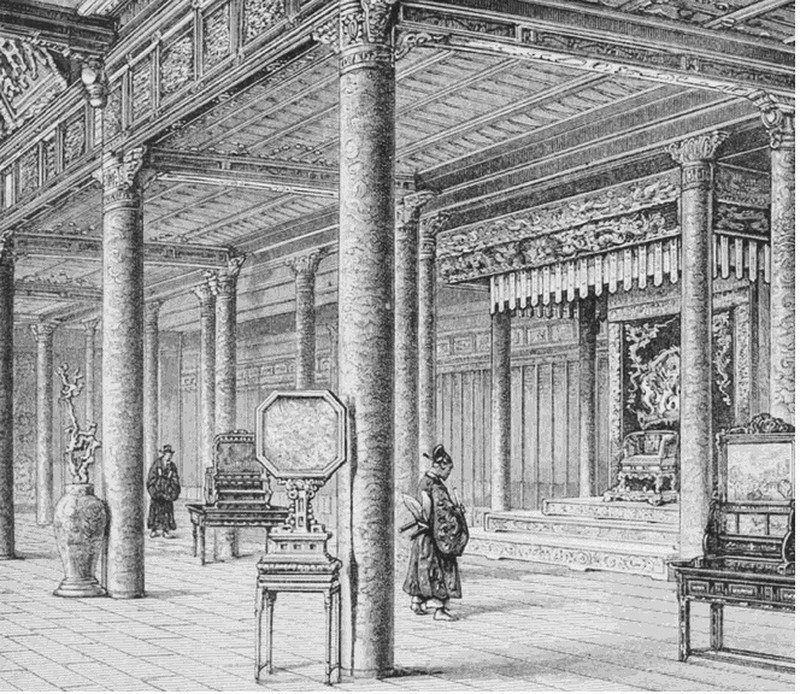
Thai Hoa Palace. Engraving according to the photograph of Dr. Hocquard
The magnificent palace of Thai Hoa occupies the entire extent of a vast building with a triple roof, the cornices and ridge caps of which are decorated with statues of mythical creatures. A succession of immense red and gold lacquered columns, which are adorned with a profusion of sculptures, rise up to the roof.
The walls are covered in beautifully carved woodworks from floor to ceiling. In the back, between two rows of columns, the Red-lacquered and gilded royal throne rests on a pedestal of three steps, whose shape recalls that of an armchair; there are also two footrests representing two reclining tigers in front of the throne.
Behind the throne is an elegant wall hanging embroidered a dragon with four claws which is the royal emblem. It is surmounted by a canopy of yellow silk, covered with colored embroidery.
It is in this room that the Emperor gives his solemn audiences, in the presence of all the mandarins of the court grouped together, outside the building, on the left and right sides of the courtyard. On these days, the large blinds used to cover the whole courtyard are completely raised.
The first palace has two small side openings with an interior courtyard, paved with large slabs. There are three large doors in red lacquer adorned with immense golden dragons. These doors open onto a second enclosure, at the bottom of which can be seen another large palace of the same architecture as the first and preceded by a paved courtyard (these red large doors are the openings of the main palace built by Minh Mang Emperor – note by translator).
Immediately after passing through the red doors, Priest Hoang puts down his shoes; he precedes me barefoot and speaks in a low voice. He demanded that I left my gossoon outside, my camera was entrusted to an official who comes to receive us in the second enclosure. He is also barefoot and follows us with a very serious face without saying a word.
This is the place of Emperor’s presence. To show great respect to him, the mandarins and royal servants must leave their shoes outside and speak in a low voice.
On the other sides, the courtyard is flanked by two rows of houses which are residences of the soldiers on guard. The Emperor ordered one of them to send me a tray of pastries and high-grade tea. While enjoying this snack, I saw an unusual procession crossing the courtyard.
A square box with four sides covered by small blinds is carried on a palanquin by soldiers in red uniforms. The box is sheltered by two yellow parasols hold by some captains while four soldiers with oddly shaped hat carrying large sabers march gravely in front. Priest Hoang explained that they brought offerings that the Emperor had placed every day on the altar of his ancestors.


 Tin liên quan


)